Timber Frame
Timeless and natural beauty that lasts for generations

* There are other wood species we can use upon your request like Cypress, Walnut, Birch, Spruce, White fir and more upon your request.
There’s a growing demand in the market right now for wood that has been reclaimed from old buildings such as churches, barns, factories, and schoolhouses. The use of reclaimed timbers is environmentally conscious while also giving your home a unique story.
While have the ability to source reclaim wood from older structures that are being disassembled, however, the timing and availability of repurposed material greatly varies. If your preference is to use reclaimed timbers in the construction of your home, contact us as early in the process as possible, especially if you are looking for a specific species of wood. Reclaimed timbers will either need to be x-rayed for unseen nails and hardware before they can be put through our machine or each individual piece will need to be cut by hand, both of which are expensive and time consuming. As a more affordable option, we can re-create the look of reclaimed timbers with the application of different surface textures and finishes. Texturing techniques such as hewn, wire brush, and axe marks (just to name a few) can create a desired vintage aesthetic.
Proper Preparation & Time-Tested Practices: Beyond your choice of woods, the method in which your timbers are prepared before they’re cut will have an impact on the frame’s strength and appearance.
Most companies cut their timber “green”, meaning that it comes fresh from the forest to the sawmill. Green timbers contain high moisture content, often over 40%, so as green timbers dry, they tend to bow, twist, shrink, and warp, affecting the stability and appearance of the overall structure. We can provide green timbers for those who desire them, however, our high, dry climate in Colorado allows us to properly air-dry our timbers in a controlled environment prior to being cut.
To facilitate the air drying process, we sticker each timber with 4x4s, setting them on blocks to expose their ends to the open air. Air-dry timbers go through a gradual drying cycle until they reach a moisture content of 19% or less, which is industry standard in accordance to the West Coast Lumber Inspection Bureau (WCLIB). Moisture content is measured as a ratio of the weight of the water in the wood relative to its dry weight and is given as a percentage (%MC). A special instrument, called a moisture meter reader, is then used to test the timber’s moisture content from the center out, prior to fabrication.
Air-drying
Air-drying is the most organic and thorough drying process available, allowing timbers to acclimate naturally. It is an option unique to our location and high, arid climate outside Denver, Colorado, giving us an advantage that very few timber frame manufacturers have accessible. We have found this to be the most inexpensive and effective way to dry our wood before it’s cut, however, we offer other alternatives for pulling moisture as well.
Convention Long Cycle Kiln
Convention long cycle kiln drying process takes about 30 days of two 15 day cycles. The initial 10-15 day rotation penetrates the first 2” of the timber. It then comes out for a week to cool down so that any moisture trapped in the middle can migrate to the outside again. The second 10-15 day cycle actually pulls moisture from the center of member, resulting in 19% or less moisture content at the center.
Radio-frequency Kiln
Another method is to use radio-frequency kilns to dry the wood. These timbers are commonly referred to RFKD (radio-frequency kiln-dried) timbers. While Colorado Timberframe does offer this as a service in cases where time is of the essence, it is much more expensive. Radio-frequency kilns act like microwave ovens, drying timbers from the inside out. While this is superior to kiln-drying, “processing” logs in this way can make their fibers respond in unexpected ways. It can make the wood twist and check more, because the “microwaving” shocks the tree’s core. Despite these possible issues, we have had good success with this process for a number of clients so believe it is a viable method if the homeowner desires.
The trees we use are responsibly harvested by reputable providers. If requested, we also have the ability to get Forest Stewardship Council (FSC) certified timbers.
Colorado Timberframe takes artistic pride in building both traditional timber frame and post and beam style structures. Both construction techniques use heavy squared off timbers rather than dimensional lumber creating a carefully constructed skeleton that becomes the primary visual element of the building. Exposed timberwork has become a mainstay in true mountain style architecture. The main difference between the two is how the timbers are connected. Traditional timber framing is an ancient building technique that utilizes precision cut mortise and tenon joinery secured by wooden pegs.
In comparison to traditional timber frame, post and beam utilizes fasteners in the form of metal bolts, screws, rods and steel plate connectors to join adjacent members together. We occasionally employ metal hardware in our designs to meet modern engineering and code requirements, however, most of the time it can be hidden. Colorado Timberframe can provide either option. The decision to use either method comes from the direction given by the client based on cost and the desire for authenticity.

A Spline is a smaller member that passes through an open mortise in the post. Two larger opposing beams are joined at the post and pegged together.

The King post and struts are connected directly to the collar tie beam, however, struts can also be connected to the King Post. A King Post truss spreads out the weight of the roof to load bearing walls.

A rafter foot meets the plate.

A rafter tenon slides in to an open mortise and secured by two pegs.

The recessed dovetail wedge interlocks with a tenon securing two members together. It is commonly used to connect roof purlins securely to joists.

A tenon slides directly in to a mortise at 90 degrees and is secured by two pegs.

The top of the King post is housed with a recessed wedge which slides in to the roof’s purlin ridge beam.

Rafters connect to the top of the King Post with a housed tenon and is secured typically by three pegs. This upper king post joinery is a classic and strong connection.

King Post trusses have a central vertical post working in tension to support a beam below from a truss above. A King Post truss spreads out the load bearing on the roof.

Two arched collar ties connect to the king post from a truss above.

Two bottom chord members cross each other, connecting to the angled top chords, creating an appearance similar to an opened pair of scissors.

Hammerbeam trusses are decorative and open, first seen in English Gothic architecture. It requires more components and joinery but uses shorter size members rather than long lengths of timber.

A queen post is a tension member in a truss that can span longer openings than a king post truss. A king post uses one central supporting post, whereas the queen post truss uses two.

This truss has both a central king post and also two supporting posts on either side of the king post.

Timbers are surfaced smooth on all four sides through a planer for a clean appearance.

Timbers are put through a band saw to create a fine sawn appearance. Resawn timbers have a coarse surface but are uniform and clean compared to rough sawn material.
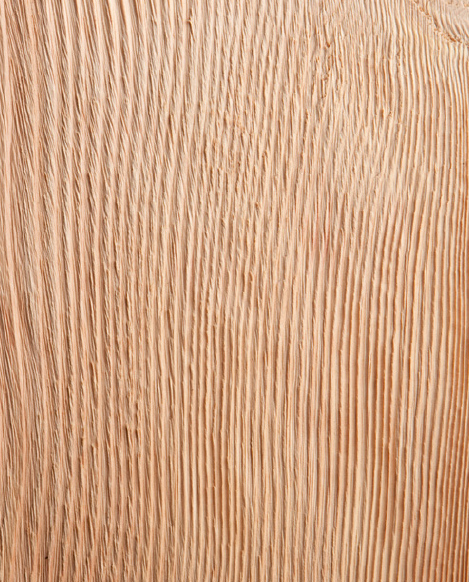
Wire brushing removes the soft grain from the surface exposing the grain patterns and creating vertical raised strokes for a three-dimensional look.

A standard hewn surface is achieved using a flat knife planer tool, creating an aged look.

A radius hewn surface is achieved using a curved blade planer tool, for a scalloped hand hewn look.
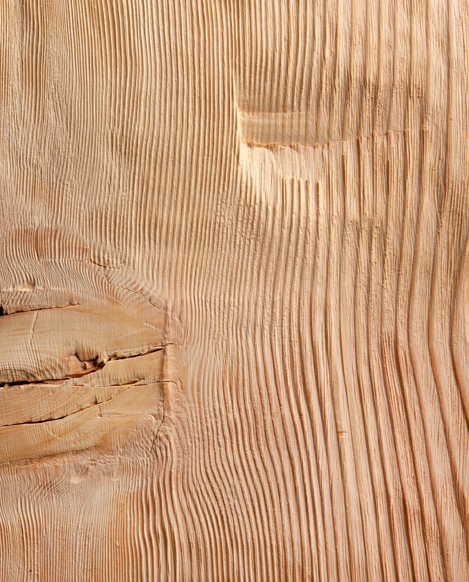
Axe marks create sharp cuts in the timber to enhance the appearance of aging.

A double texture that combines a radius hewn finish with wire brushing.